The Electrician Advantage: Real-World Problems AI Cannot Touch
AI can talk about electricity. You deal with it.
No guesses. No vibes. Just voltage, code, and consequences.
There’s a lot of noise right now about AI “replacing trades.”
We’re not buying it.
Not because AI is useless.
Because real electrical work isn’t a clean dataset.
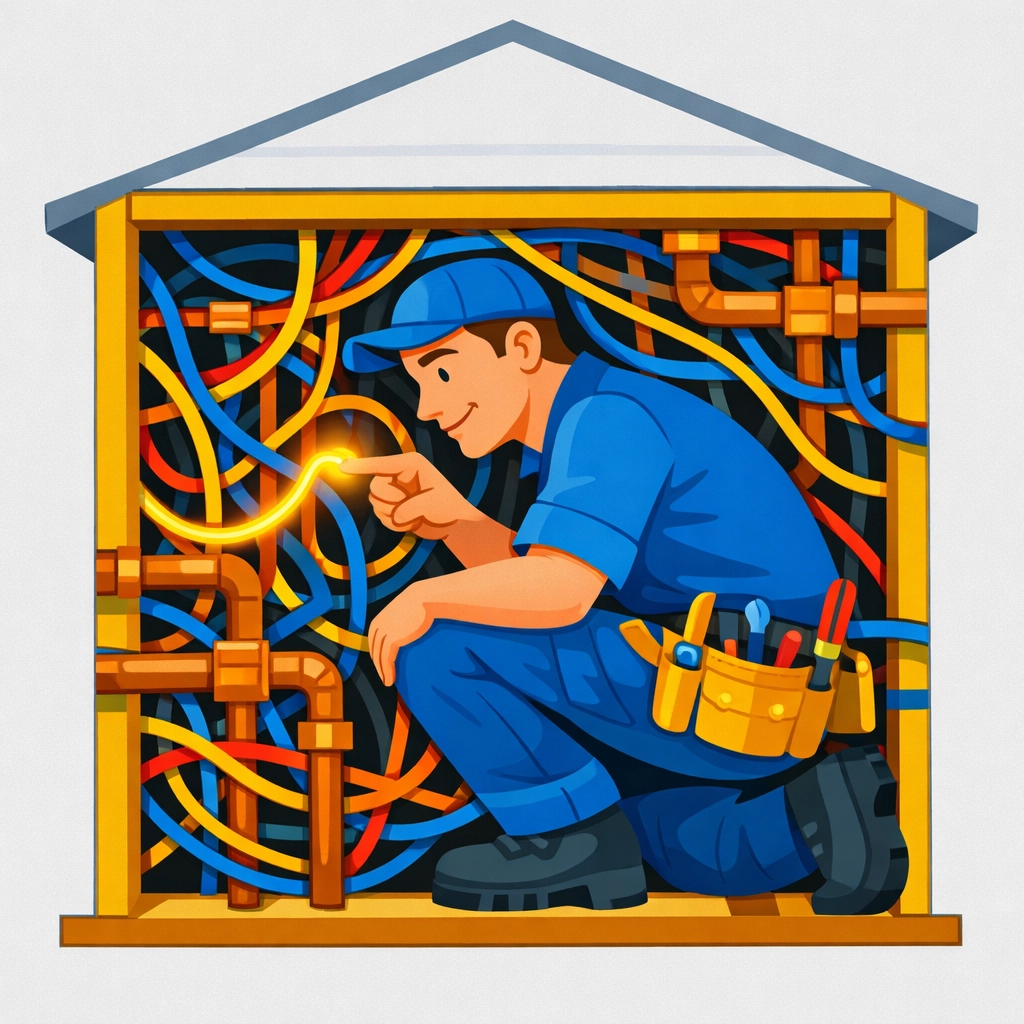
It’s cramped attics. Weird remodels. Mixed circuits. Half-labeled panels.
And customers who swear “it just started doing that yesterday.”
This post is simple: the stuff you do every day that AI can’t touch.
And why that advantage matters for your business.
AI is great at patterns. Electrical problems aren’t patterns.
AI wins when the inputs are clean. Electrical systems almost never are.
No perfect diagrams. No consistent installs. No “standard” anything.
A model can learn from thousands of textbook cases.
But your Tuesday job is a Frankenstein system built across three decades.
Think about what you actually troubleshoot:
- A flickering light that only happens when the dryer kicks on
- A GFCI that trips “randomly” after rain
- A remodel where someone tied neutrals together because it “worked”
- A service upgrade where half the labeling doesn’t match reality
That’s not a multiple-choice test.
That’s a field puzzle.
You don’t just identify the problem. You define the problem.
AI can’t do that reliably without perfect sensors, perfect documentation, and perfect history.
And those don’t exist in most buildings.
Troubleshooting is judgment. Not lookup.
The best electricians don’t memorize more. They reason better.
No script. No checklist-only thinking. Just decisions that fit the situation.
You notice the small stuff:
- Heat where there shouldn’t be heat
- A smell that means “stop right now”
- A buzzing that isn’t “normal transformer hum”
- A breaker that’s warm but not tripped (yet)
That’s experience.
That’s context.
AI can recommend a likely cause.
You decide what’s safe to test, what’s safe to open, and what’s safe to leave alone until power is isolated.
No instincts. No caution. Just output.
That’s the limit.
Real job sites are messy. AI hates messy.
Electrical work happens in real places. Not lab conditions.
And real places are full of constraints.
You deal with:
- Access issues (tight crawlspaces, finished ceilings, blocked panels)
- Existing damage (water, rodents, corrosion, DIY fixes)
- Old materials (knob-and-tube, aluminum branch wiring, brittle insulation)
- “Just make it work” requests that violate code
AI can’t “see” the job site the way you do.
Even if it has a camera, it still can’t feel heat, tension, vibration, or resistance the way a human can.
And it definitely can’t negotiate the tradeoffs:
- “We can fish this wire, but the drywall repair won’t be pretty.”
- “We can replace the device, but the box is undersized.”
- “We can add a circuit, but your panel is at capacity.”
That’s not math.
That’s craft.
Electrical code isn’t just rules. It’s interpretation.
AI can quote code. You apply it.
Huge difference.
The NEC is detailed, but job sites aren’t.
And local AHJs don’t all enforce the same way.
You’re constantly balancing:
- Code requirements
- Manufacturer specs
- Load calculations
- Site constraints
- Inspection expectations
- Customer budget (without cutting corners)
AI can pull the “right” paragraph.
But when the panel is in a closet, the framing is wrong, and the customer wants it done today, you’re the one making it safe and compliant.
No accountability. No inspection. Just suggestions.
That’s not enough for real work.
Physical labor is the job. AI can’t lift, pull, drill, or sweat.
Let’s be blunt: electricity is not solved on a keyboard.
It’s solved with tools, hands, and time.
AI can’t:
- Pull wire through a packed conduit run
- Set anchors in concrete
- Replace a service mast in wind and snow
- Terminate conductors correctly under torque specs
- Cut, bend, mount, and level actual gear
- Work safely on ladders and lifts
- Move through a job without damaging finished surfaces
Even the “robot electrician” idea falls apart fast.
Because every building is different, every wall is different, every surprise is different.
No muscles. No mobility. Just talk.
Talk doesn’t fix a failed neutral.
Safety isn’t optional. And AI can’t own it.
Electricians don’t just fix problems. You prevent disasters.
That’s the part outsiders miss.
A lot of electrical work is risk management:
- Arc flash exposure
- Fault current realities
- Lockout/tagout discipline
- Proper PPE choices
- Knowing when to stop and re-plan
AI doesn’t feel risk.
It doesn’t get tired. It doesn’t get rushed. It doesn’t get complacent.
But it also doesn’t care if it’s wrong.
You do.
Because “wrong” can mean:
- Fire
- Injury
- Liability
- Failed inspection
- A customer who never calls you again
No stakes. No consequences. Just probability.
And probability is a terrible safety plan.
The customer side is half the job. AI can’t do trust.
You’re not just wiring circuits. You’re managing people.
Anxiety, urgency, confusion, skepticism. All of it.
Customers ask things like:
- “Is this dangerous?”
- “Is this going to happen again?”
- “Why is it so expensive?”
- “Can you do it today?”
- “Are you sure we need a new panel?”
AI can answer.
But it can’t read the room.
You can.
You know when to slow down and explain.
You know when to draw a quick diagram on a notepad.
You know when to say, “I’m not leaving this like this.”
That’s trust.
And in the trades, trust is your marketing.
What AI can do for electricians (and we’re fine admitting it)
We’re not anti-AI. We’re anti-hype.
No fear. No fantasy. Just useful tools.
AI is solid at:
- Summarizing notes into clean job descriptions
- Drafting customer-facing explanations (that you review)
- Organizing photos by job and room
- Spotting trends across lots of jobs (callbacks, parts usage, time sinks)
- Helping you write faster estimates and follow-ups
But notice the pattern: AI supports the work. It doesn’t replace it.
The win is simple.
You stay in control. You stay accountable. You stay the pro.
AI handles the busywork.
The real risk isn’t AI. It’s admin overload.
Most electricians don’t lose time to the tools. You lose time to the office.
No offense to “software.” But most of it is built for someone else.
Here’s what we see over and over:
- Your schedule is in one place
- Customer info is in another
- Estimates are in a spreadsheet
- Invoices are in accounting software
- Photos are on your phone
- Notes are… somewhere
- And every handoff costs you time
That’s where businesses leak money.
Not because the work is hard. Because the workflow is fragmented.
And that’s where we come in.
We’re not another “enterprise platform.” We’re the ops layer you actually use.
Valortek is built to make the business side of your trade simpler.
No bloated dashboards. No “digital transformation” speeches. Just the basics done right.
What we care about:
- Clear scheduling
- Clean job records
- Fast estimates and invoices
- Less re-typing the same info
- Better visibility on what’s profitable
- Fewer surprises at the end of the month
You already have the electrician advantage.
We help you run it like a business.
If you want to learn more about how we handle data and privacy, it’s here: https://www.valortek.com/privacy
The bottom line: your value is in the messy middle
AI can’t crawl into the attic, read the panel, and make the call.
You can.
AI can’t balance safety, code, customer expectations, and physical reality in real time.
You do that every day.
So if you’re worried about being “replaced,” don’t be.
Worry about being buried in admin while you’re out doing the hard work.
Let software do the paperwork.
Let humans do the trade.
Questions? Contact us – we’re happy to help you decide.
Ready to Transform Your Business?
See how Valortek can help you work smarter, not harder