HVAC Diagnostics: Why Your Local Pro Still Beats AI Every Time
AI is getting better at HVAC diagnostics.
It’s also not climbing into your attic.
No ladders. No gauges. No smell test.
Just data.
And that’s the whole point of this post.
We’re not “anti-AI.”
We’re anti-fantasy.
If you run an HVAC business, you’ve probably heard the pitch: “AI will diagnose the issue before you arrive.”
Sometimes it can help.
A lot of times it can’t.
Let’s break down where AI is genuinely useful, where it falls apart, and why the best shop in town is still the one with solid techs and good judgment, plus the right tools.
AI is a tool. Not a technician.
AI shines when the system is already instrumented.
Sensors. Telemetry. Clean history. Consistent runtime data.
That’s not most residential calls.
Most service work is messy:
- The homeowner changed settings three times.
- The filter is a pet hair brick.
- The outdoor unit is half buried in cottonwood fluff.
- The thermostat wiring is “creative.”
- The condensate line is doing its best impression of a swamp.
AI doesn’t see any of that unless someone measures it, reports it, and feeds it into the system.
No hands. No eyes. No context.
Just an algorithm making guesses.
And in HVAC, guessing gets expensive fast.
What AI can do well (and you should use it for)
Let’s be fair. AI isn’t useless.
Used right, it can make you faster and tighter.
Here’s where it helps.
1) It spots patterns in data you’d never stare at all day
If you’ve got a building automation system, smart thermostats, or solid runtime history, AI can flag trends:
- Short cycling patterns
- Abnormal discharge temps
- Rising static pressure over weeks
- Compressor run-time drift
- Weird load patterns by time of day
Humans can find these.
We just don’t have the time to babysit charts.
2) It speeds up troubleshooting
Some facilities using AI-based fault detection have reported meaningful reductions in troubleshooting time and HVAC operating cost, because the system flags “check this first” faster than a person can.
AI becomes the second set of eyes.
Not the final call.
3) It enables predictive maintenance (when the inputs are real)
If you’ve got consistent sensor data, predictive alerts can reduce breakdowns.
That’s valuable in commercial and industrial work.
It’s less reliable in “my AC stopped and my toddler’s melting” work.
So yes: AI can be a boost.
But it needs one thing to work.
Good inputs.
And that’s where reality shows up.
The big limitation: AI can’t inspect anything
Diagnostics isn’t just “reading the symptoms.”
It’s verifying the cause.
AI doesn’t:
- Check a blower wheel for buildup
- Put eyes on a cracked heat exchanger
- Hear a failing bearing
- Smell a scorched contactor
- Feel a vibrating line set
- Notice the return is undersized and starving the system
And it can’t do the most important part of the job:
It can’t decide what matters and what doesn’t when the evidence conflicts.
That’s not a software problem.
That’s a “you need a human there” problem.
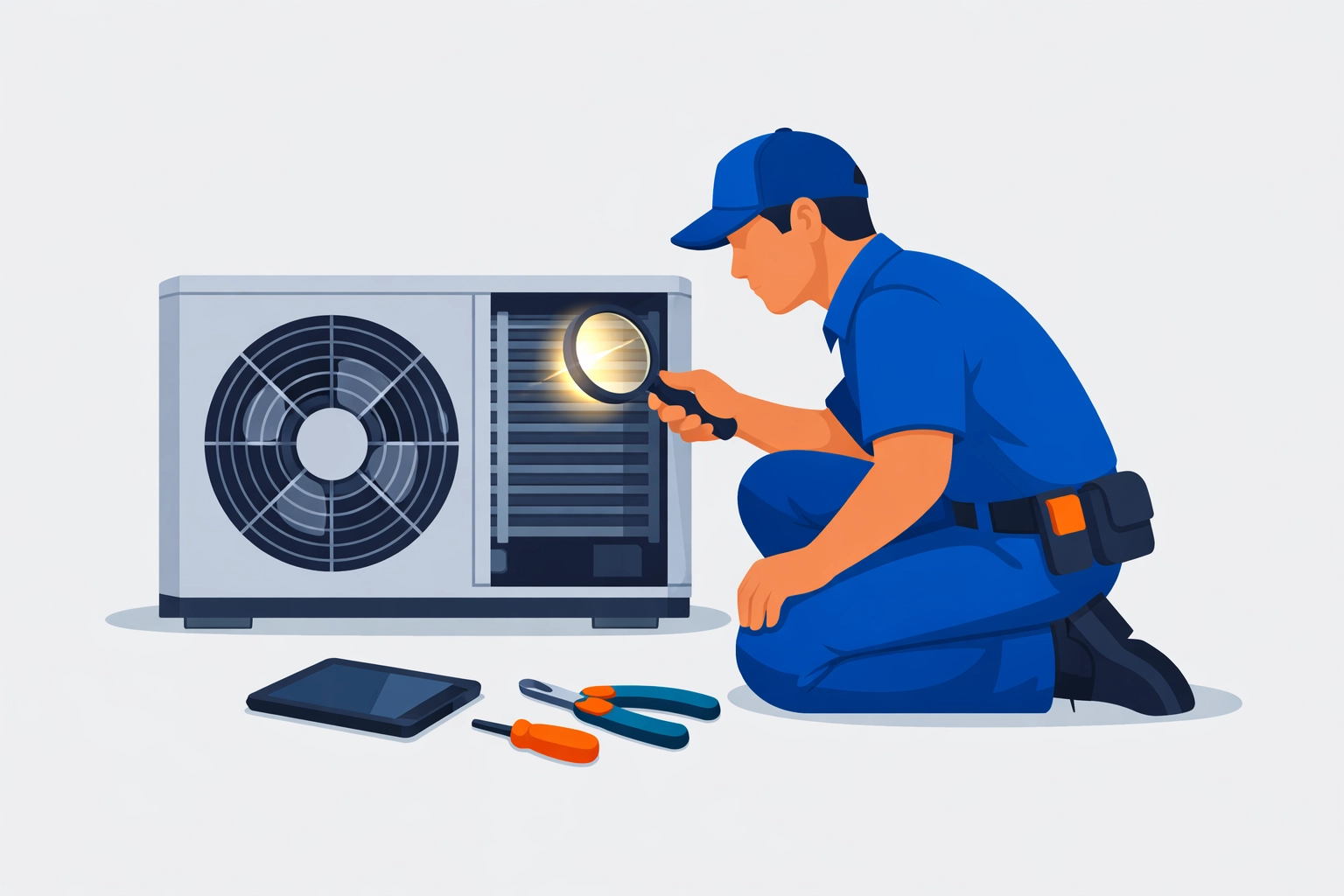
HVAC is physical. Diagnostics are physical.
A lot of AI hype assumes HVAC is like software.
It’s not.
HVAC systems live in the real world:
- Dust
- Water
- Sun
- Rodents
- Bad ductwork
- Bad installs
- “Handyman specials”
- Power issues
- Home additions with zero load calculation
Even if AI could perfectly interpret your sensor readings, it still wouldn’t know:
- The condenser is recirculating hot air because it’s boxed in
- The return is pulling attic air through a gap
- The supply trunk is leaking into a wall cavity
- The coil is freezing because airflow is low, not because refrigerant is low
- The thermostat is in direct sunlight
Most failures aren’t “mysterious.”
They’re contextual.
And context is what humans are good at.
The data problem: AI only knows what you measure
AI needs data.
Most HVAC calls don’t have it.
Even on higher-end systems, the data might be:
- Incomplete (missing sensors)
- Noisy (bad calibration, drift)
- Misleading (wrong assumptions)
- Disconnected (no unified history across equipment)
- Stale (no recent service notes)
Garbage in. Garbage out.
That’s not a slogan. That’s Tuesday.
And if you’re relying on AI as the first and only brain, you’ll end up with:
- Wrong parts ordered
- Wrong diagnosis sold
- More callbacks
- Less trust
- Lower close rates
You don’t want to be the shop known for “the algorithm said so.”
HVAC diagnostics aren’t one problem. They’re multiple problems stacked.
AI tends to do best when one cause leads to one effect.
HVAC failures often have chains.
Example: “No cooling.”
- Low airflow from a dirty filter
- Which caused coil icing
- Which caused liquid floodback risk
- Which caused poor superheat readings
- Which triggers a technician to think “refrigerant issue”
- Which leads to topping off instead of fixing airflow
- Which leads to another callback in two weeks
AI might catch coil temp anomalies.
But it won’t automatically understand the messy human behavior around it:
- Homeowner replaces filter with the wrong size
- Tech is under time pressure
- System is oversized
- Ducts were never balanced
Diagnostics is not just physics.
It’s people.
The “last mile” is where AI breaks
Even if AI points you in the right direction, the final step still needs a pro:
- Confirming readings with instruments
- Verifying airflow
- Checking electrical under load
- Inspecting mechanical condition
- Deciding repair vs replace
- Explaining tradeoffs to the customer
This is the part customers remember.
They don’t remember your dashboard.
They remember whether you fixed it, how you explained it, and whether it stayed fixed.
No script. No chatbot. Just trust.
And trust is earned in person.
Safety and liability: AI doesn’t sign the invoice
HVAC isn’t just comfort.
It’s safety.
- Gas leaks
- CO risk
- Electrical faults
- Overheated components
- Combustion air issues
- Venting issues
AI can flag anomalies.
It can’t take responsibility.
Your tech is the one who decides:
- “This is unsafe.”
- “We shut it down.”
- “Here’s why.”
- “Here’s the next step.”
If you’ve ever had to make that call in a living room with a worried homeowner, you know:
that’s not an algorithm moment.
That’s a judgment moment.
“But what about remote diagnostics?”
Remote diagnostics are real.
And they can be great.
Here’s the honest take:
- Remote diagnostics work best in commercial environments.
- They work best when the site is already heavily instrumented.
- They work best when the equipment is standardized.
- They work best when maintenance is consistent.
Residential is the opposite of that.
So if someone’s telling you AI can replace dispatch, replace techs, and replace on-site work…
they’re selling you a story.
No truck. No tools. No problem?
Not in HVAC.
Where AI helps your HVAC business without pretending to replace you
This is where we like to live: practical tools that don’t insult your intelligence.
AI can help in areas adjacent to diagnostics, places where speed and consistency matter, and the risk of “AI hallucinating” won’t fry a compressor.
✅ Better triage at intake
AI can help you standardize what questions get asked on a call:
- “Is the outdoor unit running?”
- “Any ice on the line?”
- “Any burning smell?”
- “When did it start?”
- “Any recent work done?”
Not replacing your dispatcher.
Just making intake tighter.
✅ Cleaner notes and better handoffs
Tech notes matter.
AI can help summarize, structure, and clean up notes so:
- The next tech isn’t guessing
- Your office can invoice faster
- You can spot repeat issues
✅ Predictive reminders (filters, maintenance, warranties)
AI isn’t diagnosing the compressor.
It’s reminding customers to do the basics that prevent breakdowns.
That’s not hype.
That’s revenue and fewer emergency calls.
✅ Inventory and parts forecasting
If you track parts usage, AI can help predict what to stock.
Not magic.
Just math at scale.
The best diagnostic system is still a great process
Here’s what wins in the real world.
No buzzwords. No “digital transformation.” Just fundamentals.
A diagnostic workflow your techs actually follow
- Verify the complaint
- Check airflow first
- Check electrical second
- Check refrigerant last (and only after airflow is confirmed)
- Confirm with measurements, not vibes
- Document before/after readings
A consistent way to capture job data
If you want AI to help later, you need consistent inputs now:
- Model/serial
- Installed date (if known)
- Photos
- Static pressure readings (when relevant)
- Delta T
- Superheat/subcooling (when relevant)
- Parts replaced
- Root cause notes (not just “fixed”)
AI can’t create discipline.
But discipline can create data.
And data can actually help you scale.
Customers don’t want AI. They want certainty.
Homeowners don’t call you because they want innovation.
They call because they want their house comfortable again.
They want:
- A clear answer
- A fair price
- A fix that lasts
- A tech who seems competent and calm
AI can support that.
It can’t be that.
The shops that win with AI will be the ones who use it quietly, behind the scenes, to reduce waste, without pretending it replaces craftsmanship.
No robot techs. No remote miracles. Just better service.
That’s the lane.
How we think about it at Valortek
We’re not another bloated “platform” built for enterprise facilities teams.
We’re not trying to replace your techs with prompts and dashboards.
We build tools that help your operation run cleaner:
- Better scheduling
- Better job tracking
- Better customer visibility
- Better follow-up
- Better internal accountability
No complexity for the sake of complexity.
No features you’ll never use.
Just a system your team can actually stick with.
If you want to learn more about who we are, you can poke around here: https://valortek.com
The bottom line
AI can flag.
It can suggest.
It can accelerate.
But it can’t crawl into a tight attic and tell you the return’s undersized.
It can’t look a customer in the eye and explain why replacement is the right call.
It can’t keep your reputation intact when the easy answer is wrong.
So yes: use AI.
Just don’t outsource your judgment.
That judgment is your edge.
And your local pros? They’re still the difference.
Questions? Contact us – we’re happy to help you decide.
Ready to Transform Your Business?
See how Valortek can help you work smarter, not harder